

Daily Alignment Synch (DAS nice) Protocol
Daily Alignment Synch (DAS nice) Protocol
The Daily alignment synch (das nice) protocol:

Shift Your Perspective, Reclaim Your Agency
If you are navigating the aftermath of high-stress professional environments, systemic workplace targeting, or neurocognitive recovery (TBI), your brain has likely adapted a Negative Disposition. This is a biological survival mechanism where your neural pathways have become hyper-specialized in scanning for threats and concentrating on "bad" data.
This page introduces The Daily Alignment Sync (DAS nice), a dual-purpose protocol designed to disrupt these recursive stress loops. Whether you are a patient looking for a no-pressure way to retrain your focus, or a provider seeking the clinical architecture behind neuro-alignment, you will find the tools here to move from a state of "Protection" back to a state of "Growth."
The Daily Alignment Sync (DAS nice): Reclaiming & Maintaining Your Inner Light
When you have been under intense stress or are recovering from a brain injury, your mind develops a Negative Disposition. This means your brain has become an expert at looking for bad things and ignoring the good. It is a survival habit, but it’s one you can change.
The Daily Alignment Sync (DAS nice) is a no-pressure way to retrain your brain to see the full picture again.
Guidelines
Time: This is not a race. Take as much or as little time as you need.
SpaceTime: You can pick things from today, yesterday, or a favorite memory from 10 years ago. If it feels good, it counts.
Simplicity: This isn't a long diary entry. Just a quick note for each step.
For current and prospective Clients:
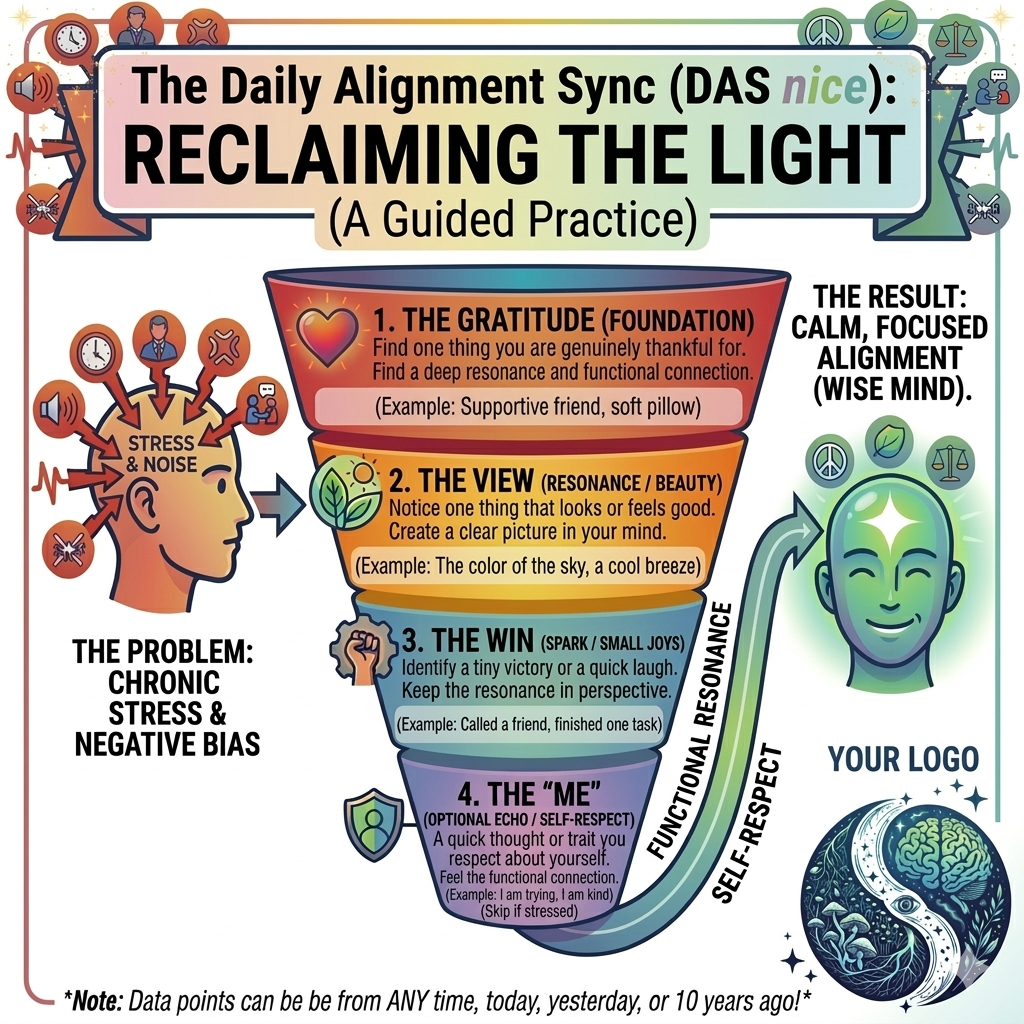
Why This Practice Helps: The "Filter" in Your Brain
When you have been through high stress or a brain injury, your mind starts to work like a high-security guard. It becomes an expert at spotting "bad data"—threats, mistakes, or things that might go wrong. This is called Negative Concentration. While it’s trying to protect you, it often leaves you feeling drained, stuck, and unable to see the "good data" right in front of you.
Think of your brain like a camera lens. If the lens is permanently zoomed in on a crack in the pavement, you’ll never see the sunrise. The DAS nice Practice is a gentle way to zoom that lens back out.
By doing these four steps, you aren't just "thinking happy thoughts." You are actually:
Cleaning the lens: Helping your brain's internal filter (the RAS) notice things other than stress.
Calming the guard: Signaling to your nervous system that it is safe to rest for a moment.
Building Momentum: Proving to yourself that you still have the ability to notice beauty and achieve small things.
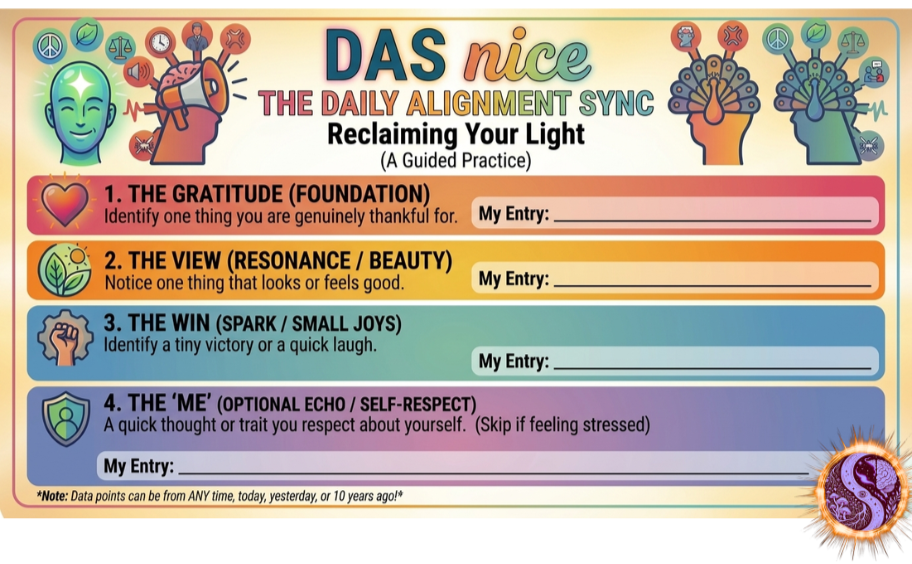
DAS nice Log; Available to the public
Clinical Architecture: Disruption of the Negative Disposition and SNS Recursive Loops
I. Neuro-Biological Recalibration: Modulating the RAS The Daily Alignment Sync (DAS nice) is a multimodal cognitive intervention engineered to interrupt the recursive loops of the Sympathetic Nervous System (SNS) and the entrenched Negativity Bias. In patients presenting with chronic workplace distress, gaslighting, or Post-Concussive Syndrome (TBI), the brain’s architecture often enters a state of "Negative Concentration." This is characterized by hyper-vigilance and a high-pass filter for threat-based stimuli.
By directing cognitive energy toward low-stakes, positive-valence data, the protocol modulates the Reticular Activating System (RAS). The RAS serves as the brain’s primary filter; through deliberate "priming" via the DAS nice steps, we facilitate a cortical reorientation. This strengthens the Prefrontal Cortex’s (PFC) top-down regulatory capacity over the Amygdala, reducing the signal-to-noise ratio of perceived threats.
II. Polyvagal Theory & Somatic Grounding Integrating Stephen Porges’ Polyvagal Theory, this practice utilizes sensory resonance ("The View") as a mechanism for Ventral Vagal anchoring. Patients in a chronic "Freeze" or "Fight/Flight" state (Sympathetic/Dorsal Vagal dominance) require non-threatening portals back to homeostasis. By engaging with aesthetic or sensory-pleasing stimuli, we encourage parasympathetic dominance and social engagement system activation.
III. Affective Science: The Broaden-and-Build Mechanism The protocol employs Barbara Fredrickson’s Broaden-and-Build Theory, which posits that positive emotions broaden an individual's momentary thought-action repertoire. In the context of "The Small Joys," these micro-bursts of positive affect serve to "undo" the lingering cardiovascular and neurochemical effects of the stress response. Over time, this builds enduring personal resources, transforming a "Survival Mind" into a "Wise Mind."
IV. Implementation Matrix & Clinical Objectives
The Gratitude (The Foundation): Targets the ventral tegmental area to stimulate dopaminergic and oxytocinergic pathways, providing a neurochemical buffer against cortisol.
Sensory Anchoring (The View): Mitigates dissociative rumination by anchoring the patient in the somatic present.
"The Small Joys" (Momentum): Specifically targets Learned Helplessness. By validating micro-successes that are ego-syntonic, we rebuild self-efficacy without the performance pressure that often triggers trauma-related "shame-spirals."
Self-Concept (The "Me"): Assists in the gradual reconstruction of the self-schema. This is marked as optional to maintain patient safety, as direct self-praise can be invalidating or triggering during acute crisis.
THE PROVIDER PROTOCOL
Comprehensive Bibliography & Professional Source List
Amen, D. G. (2020). The End of Mental Illness: How Neuroscience is Transforming Psychiatry. Tyndale Momentum.
Baumeister, R. F., et al. (2001). "Bad is Stronger than Good." Review of General Psychology, 5(4), 323–370.
Emmons, R. A., & McCullough, M. E. (2003). "Counting blessings versus burdens: An experimental investigation of gratitude and subjective well-being in daily life." Journal of Personality and Social Psychology, 84(2), 377–389.
Fredrickson, B. L. (2001). "The role of positive emotions in positive psychology: The broaden-and-build theory of positive emotions." American Psychologist, 56(3), 218–226.
Hanson, R. (2013). Hardwiring Happiness: The New Brain Science of Contentment, Calm, and Confidence. Harmony.
Linehan, M. M. (2014). DBT Skills Training Manual (2nd ed.). Guilford Press.
Porges, S. W. (2011). The Polyvagal Theory: Neurophysiological Foundations of Emotions, Attachment, Communication, and Self-regulation. W. W. Norton & Company.
Southwick, S. M., & Charney, D. S. (2018). Resilience: The Science of Mastering Life's Greatest Challenges. Cambridge University Press.
Van der Kolk, B. (2014). The Body Keeps the Score: Brain, Mind, and Body in the Healing of Trauma. Penguin Books.
Ownership & Copyright Notice
© 2026 SSSYNCHRONICITIES, LLC. All Rights Reserved.
The Daily Alignment Sync (DAS nice) framework, including all associated diagrams, text, and instructional graphics, is the exclusive intellectual property of SSSYNCHRONICITIES, LLC
This content is provided for personal use and individual growth. No part of this website or its original materials may be reproduced, redistributed, or modified for commercial purposes without express written permission. Unauthorized use, including "lifting" the DAS nice methodology or design for public distribution, is strictly prohibited and protected by copyright law.